
Husband Bishop Daniel Alexander Payne [8216]
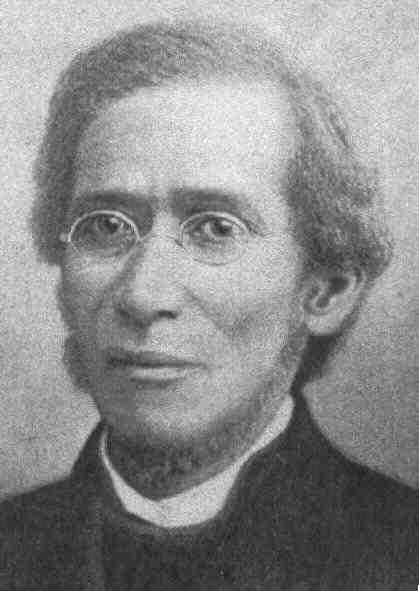
           Born: 24 Feb 1811 - Charleston, South Carolina, United States 1
     Christened:
           Died: 2 Nov 1893 - Xenia, Greene, Ohio, United States 1
         Buried: 1893 - Laurel Cemetery, Johnsville, Carroll, Maryland, United States 1
FamilySearch ID: GHNM-LDQ
Find A Grave ID: 6141266
Marriage: 12 Oct 1854 - Hamilton, Ohio, United States 1
Events
• Biography: Renowned AME Church bishop and educator. Payne became the sixth bishop of the African Methodist Episcopal(AME) Church. Payne purchased Wilberforce University, near Xenia, Ohio, from the Methodist Episcopal Church. He became president of the institution and, during his 13 years as president, placed the school on a firm financial footing. In 1865 he founded the South Carolina Conference of the African Methodist Episcopal Church, which became a launching pad for building the church throughout the south. In 1866, lengthy historical research he had accomplished permitted him to publish his "Semi-Centenary and the Retrospection of the African Methodist Episcopal Church Church in the United States of America." In 1876 Payne resigned as president of Wilberforce but stayed at the school as chancellor and dean of the theological school. The church relieved him of some of his episcopal duties so he could have time to write. During the 1880s he produced two important works, "Treatise on Domestic Education"(1885) and "Recollections of Seventy Years" (1888). The Payne Theological Seminary of Wilberforce University, as well as many AME churches, are named in his honor.
• Biography: -- -- -- -- --
.
In Memory of
Bishop Daniel Alexander Payne.
.
-- -- -- -- --
.
..."Born in 1811, Daniel Alexander Payne was the principal figure in the African Methodist Episcopal (AME) Church during the second half of the nineteenth century, a period one historian termed "the era of Bishop Daniel Payne."
.
"Daniel Alexander Payne was born free in Charleston, South Carolina, on February 24, 1811. His parents London and Martha Payne were part of the "Brown Elite" of free blacks in the city. Both died before he reached maturity. While his great-aunt assumed Daniel's care, the Minors' Moralist Society assisted his early education. Payne was raised in the Methodist Church like his parents. He also studied at home, teaching himself mathematics, physical science, and classical languages. In 1829, at the age of 18, he opened his first school.
.
After the Nat Turner Rebellion of 1831, South Carolina and other southern states passed legislation restricting the rights of free people of color and slaves. They enacted a law on April 1, 1835, which made teaching literacy to free people of color and slaves illegal and subject to fines and imprisonment. With the passage of this law, Payne had to close his school.
.
In May 1835, Payne sailed from Charleston to Philadelphia in search of further education. Declining the Methodists' offer, which was contingent on his going on a mission to Liberia, established as a colony for free blacks from the United States, Payne studied at the Lutheran Theological Seminary at Gettysburg in Pennsylvania. He did not complete ordination, having to drop out of school because of problems with his eyesight.Payne married in 1847, but his wife died during the first year of marriage from complications of childbirth. In 1854, he married again, to Eliza Clark of Cincinnati.
.
By 1840, Payne started another school. He joined the African Methodist Episcopal Church (AME) in 1842. He agreed with the founder, Richard Allen, that a visible and independent black denomination was a strong argument against slavery and racism. Payne always worked to improve the position of blacks within the United States; he opposed calls for their emigration to Liberia or other parts of Africa, as urged by the African Colonization Society and supported by some free blacks. In 1848, Payne was named the historiographer of the AME Church. In 1852, Payne was elected and consecrated the 6th bishop of the AME denomination. He served in that position for the rest of his life.
.
Payne served on the founding board of directors of Wilberforce University in Ohio in 1856. It was the first historically black college in which African Americans were part of the founding. In one of the paradoxical results of slavery, by 1860 most of the college's more than 200 paying students were mixed-race offspring of wealthy southern planters, who gave their children the education in Ohio which they could not get in the South. The men were examples of white fathers who did not abandon their mixed-race children, but passed on important social capital in the form of education; they and others also provided money, property and apprenticeships. With the Civil War, the planters withdrew their sons from the college and the college had to close temporarily because of financial difficulties. In 1863, Payne persuaded the AME Church to buy the debt and take over the college outright. Payne became the first African American college president in the United States. Payne led the college until 1877.
.
After the Civil War, Payne returned to the South for the first time in 30 years. Knowing how to build an organization, he took nine missionaries and worked with others in Charleston to establish the AME denomination. He organized missionaries, committees and teachers to bring the AME church to freedmen. A year later, the church had grown by 50,000 congregants in the South. By the end of the Reconstruction era in 1877, AME congregations existed from Florida to Texas, and more than 250,000 new adherents had been brought into the church.
.
Payne died on November 2, 1893, having served the AME Church for more than 50 years."
.
ALSO SEE: http://en.wikipedia.org/wiki/Daniel_Payne
.
END.
• His funeral was held The Baltimore Sun on 10 Feb 1894. Bishop Daniel A. Payne's Body Arrives.
The body of Bishop Daniel A. Payne, of the African Methodist Episcopal Church, who died last Wednesday at Wilberforce, Ohio, was brought to Baltimore yesterday and taken to Bethel African Methodist Episcopal Church on Saratoga street, near Gay street.
Funeral services were held at Wilberforce Sunday afternoon. The services were conducted by Bishop Benjamin W. Arnett, of Wilberforce, assisted by Bishops Moses B. Salters, of South Carolina; Benjamin T. Tanner, of New Jersey; H. M. Turner, of Michigan, and Rev. Dr. Gassaway, of Ohio. The remains were put on a train after the services and brought to Baltimore. The officiating bishops, together with Bi9shop A. W. Wayman, Rev. C. S. Smith, of Nashville; Rev. W. H. Brown, of Pittsburg; Bishop James A. Handy, of Kansas, President S. T. Mitchell and Professor John G. Mitchell and J. P. Shorter, of Wilberforce University, and Joshua Jones, accompanied the body to Baltimore. The body was put in front of the chancel rail at Bethel Church. The church had previously been draped with mourning and a large portrait of Bishop Payne was in front of the pulpit.
The body lay in state from 7 P.M. until 10 P.M., and was viewed by hundreds of colored people, from all parts of Baltimore. It will lie in state this morning from 8 until 11 o'clock. Funeral services will take place at noon. Bishop Wayman will preside. He will be assisted by all of the visiting bishops. The pall-bearers will be selected from Baltimore, Washington, Philadelphia, Pittsburg and Tennessee. The burial will be in Laurel Cemetery, Baltimore.
The Baltimore Sun, 5 Dec. 1893, Tue., p.10.
For a Monument to Bishop Payne.-
The Payne Monument Association, composed of bishops and preachers of the African Methodist Episcopal Church, whose object is to erect a monument to the memory of Bishop Daniel A. Payne, expects to have the monument ready for unveiling early in May next. The monument will be a simple marble shaft, costing about $500, and will be erected over Bishop Payne's grave in Laurel Cemetery, Baltimore. Bishop A. W. Wayman, the present senior bishop of the African Methodist Episcopal Church, is one of the most active workers for the monument fund. The officers and committee of the monument association are: Rev. Jacob W. Bowsor, president; H. H. Sharp, vice-president; Rev. I. F. Aldridge, secretary; Rev. James T. Morris, treasurer; Rev. J. H. Collett, Rev. O. B. Robinson, Rev. J. H. Robinson, Rev. L. H. Jackson, Rev. John Hurst, Rev. John F. Lane, Rev. I. S. Lee, executive committee.
The Baltimore Sun, 10 Feb. 1894, Sat., p.8.
Wife Eliza Jane Morris [18623] 1
           Born: 1815 - Virginia, United States 1
     Christened:
           Died: 25 Aug 1889 - Greene, Ohio, United States 1
         Buried: 1889 - Massies Creek Cemetery, Cedarville, Greene, Ohio, United States 1
FamilySearch ID: GZ5C-4Q8
Find A Grave ID: 96841311
Events
• Event: 1855. My second wife, whom I married in 1854, had three children, two under age, a lad of sixteen and a little girl of six. Before I had lived with them in Cincinnati one year I found that the city was full of very corrupting influences. I therefore took the autumn of 1855 to visit many of the interior towns of Ohio in order to find a good home in connection with a good school, where my step-children could be trained under the very best surroundings within our reach"
from: Recollections of Seventy Years
by Bishop Daniel Alexander Payne, D.D., LL.D.
Children